Abstract
Existing Human Motion Prediction (HMP) methods based on RGB-D cameras are sensitive to lighting conditions and raise privacy concerns, limiting their real-world applications such as firefighting and healthcare. Motivated by the robustness and privacy-preserving nature of millimeter-wave (mmWave) radar, this work introduces radar as a novel sensing modality for HMP, for the first time. Nevertheless, radar signals often suffer from specular reflections and multipath effects, resulting in noisy and temporally inconsistent measurements, such as body-part miss-detection. To address these radar-specific artifacts, we propose mmPred, the first diffusion-based frame- work tailored for radar-based HMP.
mmPred introduces a dual-domain historical motion representation to guide the generation process, combining a Time-domain Pose Refinement (TPR) branch for learning fine-grained details and a Frequency-domain Dominant Motion (FDM) branch for capturing global motion trends and suppressing frame-level incon- sistency. Furthermore, we design a Global Skeleton-relational Transformer (GST) as the diffusion backbone to model global inter-joint cooperation, enabling corrupted joints to dynamically aggregate information from others. Extensive exper- iments show that mmPred achieves state-of-the-art performance, outperforming existing methods by 8.6% on mmBody and 22% on mm-Fi.
Motivation
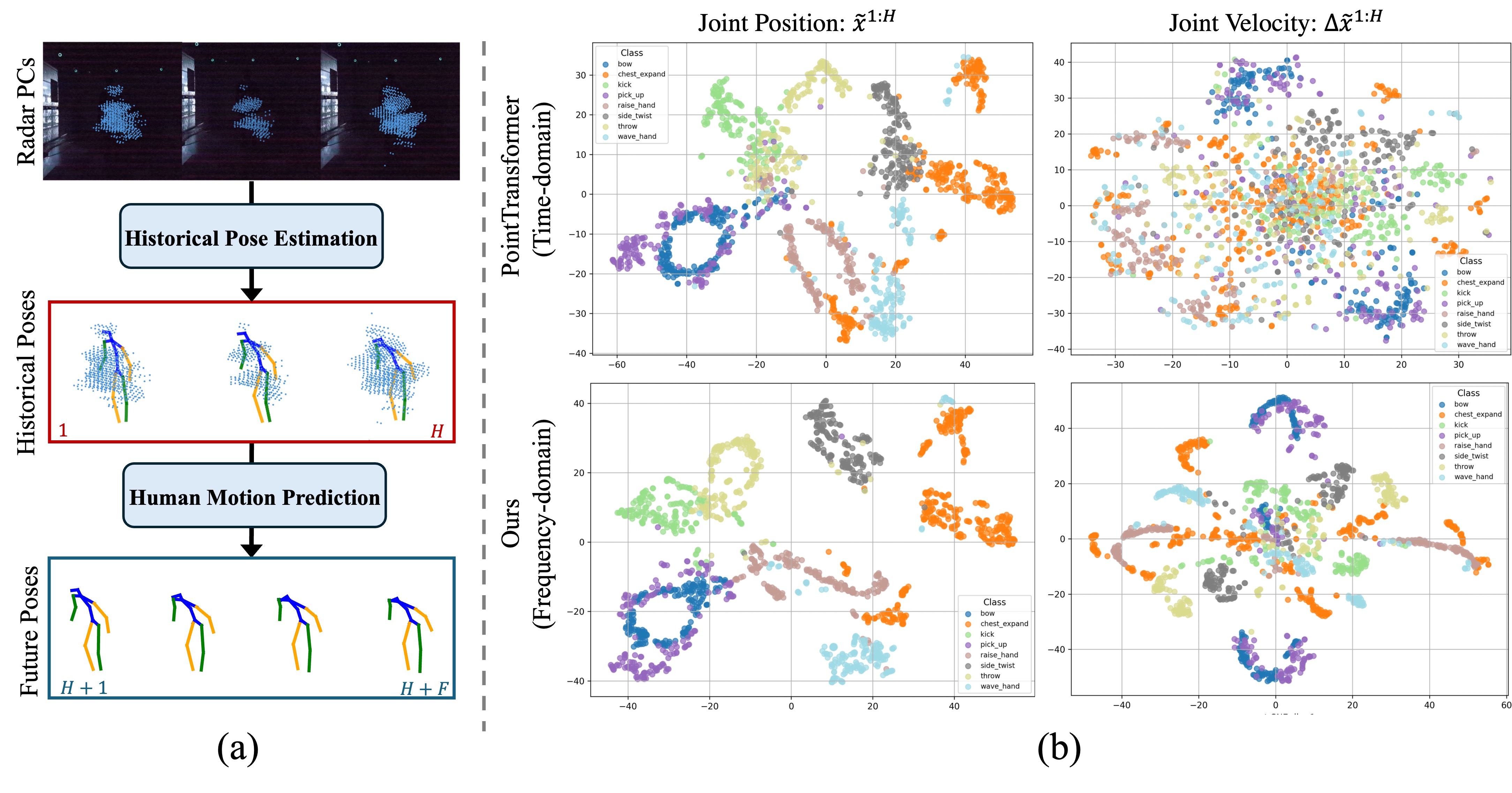
(a) mmPred can predict future poses from history radar point clouds, even under darkness. (b) Motivation of mmPred dual-domain design using t-SNE visualization of predicted historical joint locations and velocities. We compare our frequency-domain prediction with the state-of-the-art (SOTA) pose estimator (Yang et al. 2023). Our method produces more distinguishable velocity patterns across actions than existing methods.
System Architecture

System architecture: mmPred employs Dual-Domain History Estimation to extract historical motion representations in both the time (TPR) and frequency domains (FDM). These representations are fused via a feature fusion module to construct the condition embedding C, which guides the diffusion-based future motion prediction performed in the frequency domain.
Huamn Pose Prediction Result
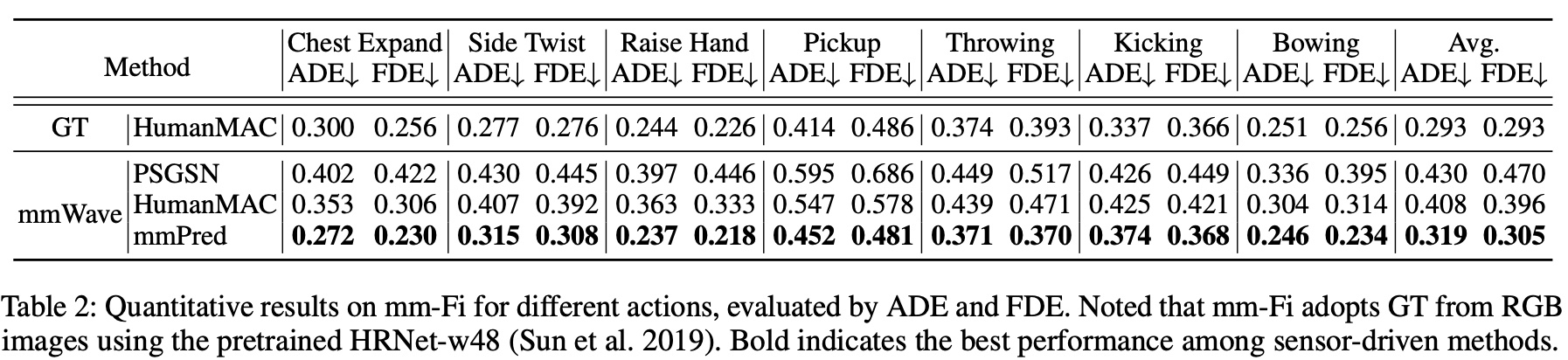
Quantative results
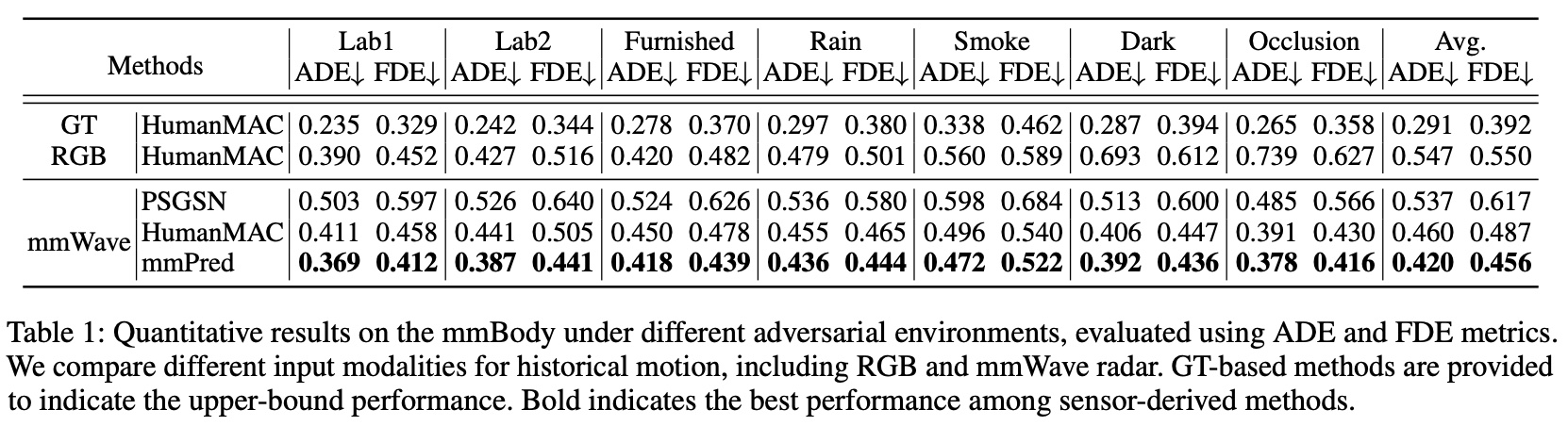
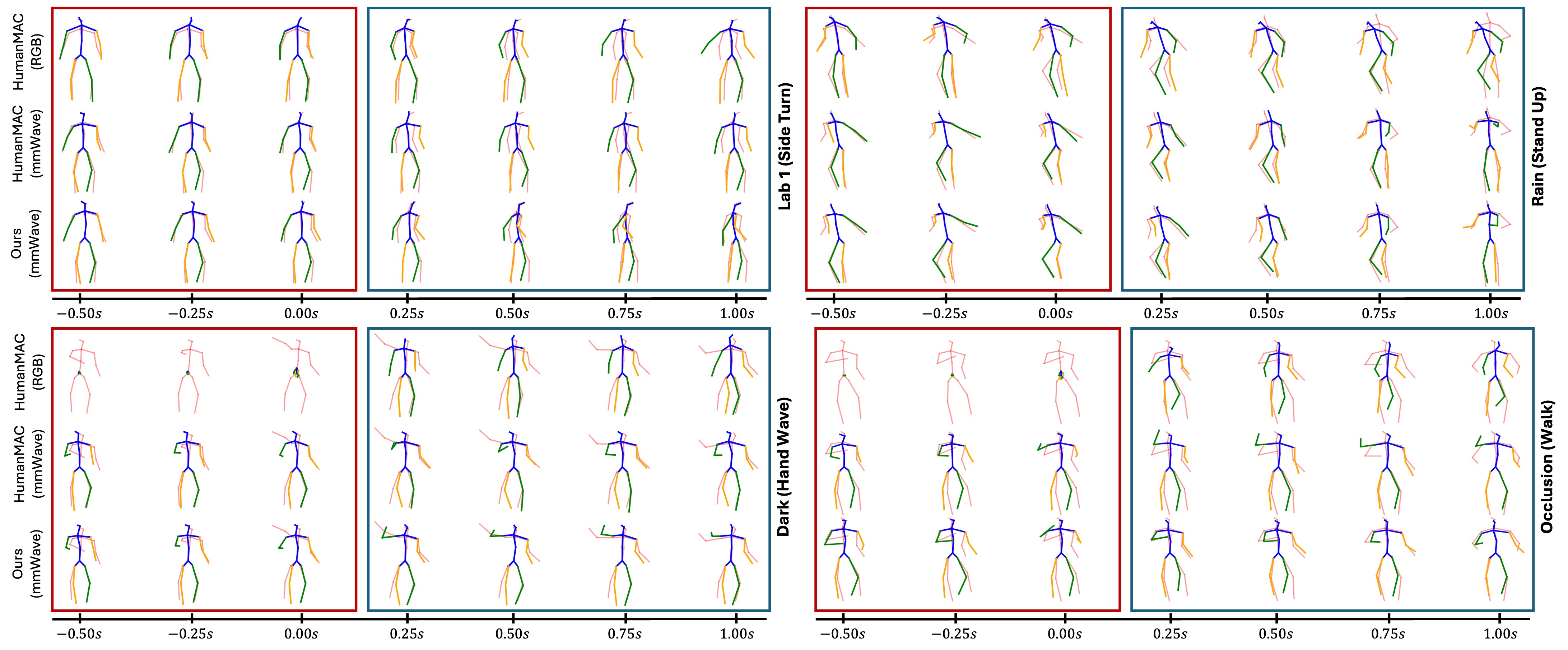
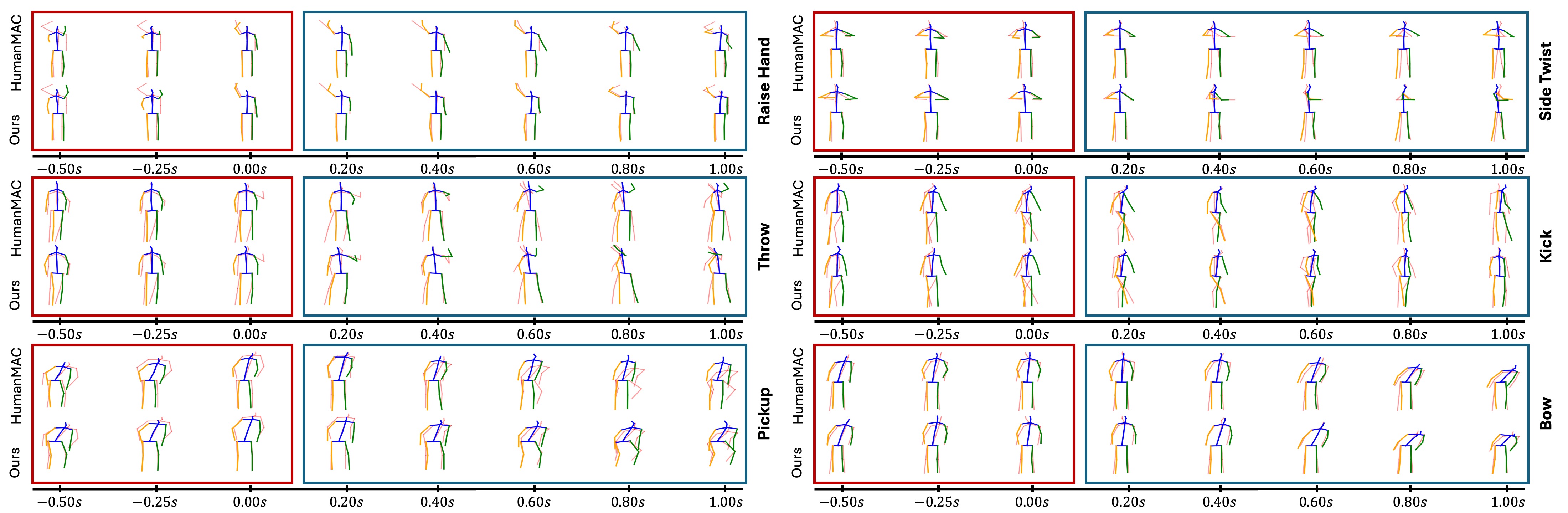
Qualitative result on mmBody dataset
Qualitative result on mm-Fi dataset
License
mmPred is released under the CC BY-NC 4.0.
Citation
@article{fan2025mmpred,
      title={mmPred: Radar-based Human Motion Prediction in the Dark},
      author={Fan, Junqiao and Rao, Haocong and Zhang, Jiarui and Yang, Jianfei and Xie, Lihua},
      journal={arXiv preprint arXiv:2512.00345},
      year={2025}
}